Basic HTML Version


It wasn’t long after the robot took up
residence that surgeons at Tri-City
Medical Center began performing
cutting-edge procedures—ones that
require quite a bit less cutting than
traditional surgeries. One of those
procedures, the first robotic cardiac
surgery ever performed in North
County, took place in an operating
room at Tri-City in November 2011.
The surgeon controlling the robot
was Dr. Paul Mazur, Tri-City cardio-
thoracic surgeon. And the patient was
66-year-old Patricio Maynigo, who
needed a heart bypass because of
a blockage in one of the vessels
supplying blood to his heart.
A Dramatic Difference
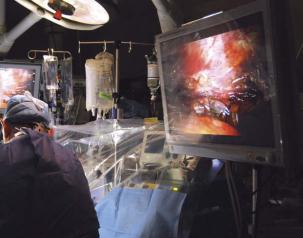
Traditionally, a bypass procedure would
have involved placing the patient on a
heart-lung machine, making a large
incision in the chest and splitting
open the chest bone. Not so with the
da Vinci. The robotic system turns
bypass surgery into a minimally invasive
procedure. Only small incisions are
needed—which results in less damage
to muscles and other organs. For the
patient, that can translate into:
• Less bleeding
• Less pain
• Faster recovery
MAJOR
HEART
SURGERY,
MINOR
RECOVERY
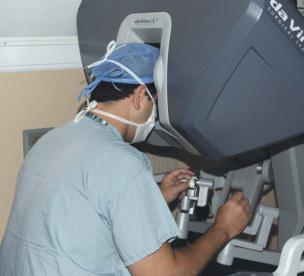
Dr. Paul Mazur works the da Vinci robot.
He performed the first heart bypass
surgery in North County using the
technology on Nov. 28, 2011.
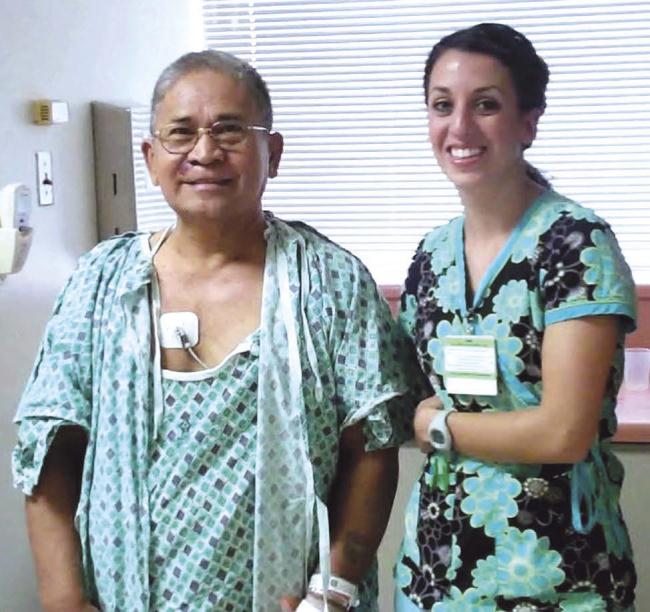
Patient Patricio Maynigo of San Marcos had nothing but kind words for his ICU nurse,
Giana Novelli.
“The da Vinci is an excellent tool that
makes my job a lot easier and the
surgery less stressful for the patient.”
—Dr. Paul Mazur, Tri-City Medical Center cardiothoracic surgeon
For the patient, that usually means
two days in the hospital instead
of four—and a few weeks of post-
surgical healing instead of months.
That’s better for everyone.
“The da Vinci is an excellent tool
that makes my job a lot easier and the
surgery less stressful for the patient,”
Dr. Mazur said.
As the da Vinci surgery program
grows, minimally invasive heart
procedures using this state-of-the-
art tool will become available to
more and more patients at Tri-City
Medical Center. That’s the kind of
cutting edge you want your hospi-
tal to have.
Patient Story
8
Healthy You
|
Winter 2012